The Lead
Last Week in AI Search: September 7–13
This week in one minute: Three things moved on the record: citation measurement, AI advertising and publisher economics. The map below is the index; each line is explained in the section it points to.
The Monday map
Study: Google AI Overviews cut Wikipedia search referrals 5%
GEO content scores barely predict AI citations, study finds
Amazon Ads pilots ChatGPT Ads buying through its DSP
Adform becomes ChatGPT Ads’ first European tech platform partner
What changed in The State of Search
Are AI answers costing me traffic?
Now: A University of Washington study added the first non-vendor, non-self-reported estimate to the record — roughly a 5% cut to Wikipedia’s search referrals, well below every self-reported figure above, and itself revised down from an initial ~15% draft estimate after methodology changes. Google disputes the estimate.
The standing answer: It depends on what you publish, and part of the disagreement is instrumentation.
Evidence: study, Search Engine Journal
Still open: Google holds the only complete dataset and has published no methodology behind “billions of clicks”. Until it does, the engine’s own position is the least checkable one in the record.
What on-page work actually moves AI citation?
Now: A study validating a deterministic GEO content-quality score re-tested the field’s original 2023 citation-lever effect sizes against ten modern AI engine families and found none of them moved citations — recalibrating the score to current data stripped it of its lever-responsive components entirely. The score’s own within-query correlation with actual citations was weak (Spearman 0.11), positioning content scores as quality filters rather than citation predictors.
The standing answer: The levers that measure are the ones that were already SEO — being in the search index, ranking well, being reachable in plain HTML, and keeping pages current.
Evidence: study, arXiv GEO
Still open: Whether entity phrasing is a content lever. Google’s own paper found models fail to recall 26-34% of facts they encoded and tied part of the gap to subject/object order, but the researchers stop short of calling it something a publisher can act on.
Can I buy my way into AI answers?
Now: two developments —
- Amazon Ads began piloting ChatGPT Ads inventory access through its own DSP for select US advertisers, with Amazon managing the buy and OpenAI still controlling ad placement — a third route into ChatGPT ad inventory alongside OpenAI’s self-service Ads Manager and managed sales. No timeline given for expanding beyond the pilot.
- Adform became the first European-headquartered name on OpenAI’s ChatGPT Ads technology platform partner roster, letting its clients manage ChatGPT campaigns alongside their other Adform-run media and connect ChatGPT-driven conversions to a single customer-journey view. Volkswagen and Vodafone named as early clients.
The standing answer: You can buy a slot, but not a citation — they are separate games.
Evidence: company announcement, Amazon Ads · PPC Land
Still open: Whether buying an ad affects the odds of being cited at all, in either direction. The 3.63% overlap is a snapshot of co-occurrence, not a test — nobody has run the same queries with and without a live campaign.
Read the item → · Read the item →
Will the courts stop AI engines from using my content?
Before: No author suing on his own, without a lawyer, had tried to keep a court from ruling on an AI company’s fair-use defense by promising not to sue over the copies made for training.
Now: Gilbert, who is suing Anthropic without a lawyer over his book, promised not to sue over the copies Anthropic made to train its models, then asked the court to throw out Anthropic’s fair-use claim as no longer worth deciding. Anthropic objected: its claim rests on the infringement case Gilbert is still pursuing and on his argument that the court may not consider why Anthropic copied — not on any fear of a second lawsuit.
The standing answer: Not so far.
Evidence: court filing, Chat GPT Is Eating the World
Still open: Whether roughly $3,000 per work becomes a benchmark or stays a one-off. Bartz settled rather than ruled, so it binds nobody — and no other case has produced a number.
The State of Search keeps one current, sourced answer to each recurring practitioner question. These are the answers this week’s items moved.
The patterns behind it
The week’s recurring themes: several items, several subjects, more than one outlet.
Citation measurement
6 items · 10 subjects · 6 outlets · 4 days
- ChatGPT, Perplexity, AI Overviews audited on mental health citations
- Profound: answer engines tailor brand picks to demographics
- BrightEdge: Reddit’s ChatGPT education citations hit zero
AI advertising
4 items · 5 subjects · 3 outlets · 4 days
- Google Ads AI dashboards go live for some advertisers
- Amazon Ads pilots ChatGPT Ads buying through its DSP
- Adform becomes ChatGPT Ads’ first European tech platform partner
Publisher economics
3 items · 6 subjects · 3 outlets · 4 days
- Publishers spent $113M on paid search as AI erodes traffic
- Le Monde CEO: no AI Overviews traffic decline in France
- People Inc. sites and The Atlantic block GPTBot, still bill Claude, Perplexity
How we count: a cluster is three or more items on one theme, naming three or more different companies, engines or studies, from at least two outlets, inside the week.
Numbers to keep
From this week’s items, as entered on The Numbers. Evidence type is labelled so a study, a vendor’s measurement, a company’s claim and first-party data read differently.
| Number | What it measures | Evidence |
|---|---|---|
| 43.6% | Share of English-language citations held by the ten most-cited domains, in a cross-platform audit of ChatGPT, Perplexity and Google AI Overview on 20 English mental-health questions plus six additional languages … | arXiv preprint, not yet peer reviewed |
| 1 in 4 | Rate at which ChatGPT, Gemini and Claude recommended the same brand to two different personas asking the identical question, versus roughly 2 in 5 when the same persona repeated the question — across 71,147 responses built from income, age … | Profound study — vendor-published |
| 17.2% to 0% | Reddit’s share of ChatGPT’s Education-category citations over two weeks in August 2026, per a BrightEdge analysis tracking a fixed weekly panel of U.S. education prompts from week 28 through week 37 (July 6-Sept 13). | BrightEdge study — vendor-published; causal claim (Reddit’s robots.txt) is BrightEdge’s own attribution, not independently confirmed |
| +7% | Le Monde’s English-language traffic growth in H1 2026 versus H1 2025, roughly seven weeks after Google’s AI Overviews launched in France — CEO Louis Dreyfus also cited 24,000 new subscribers in each of July and August 2026. | single-source — confirmation pending |
| 1.20% to 1.55% | Google Shopping ads’ median click-through rate, mid-2025 to mid-2026, even as impressions fell from roughly 1.85 million to 1.4 million — the inverse of the “crocodile effect” seen in organic search … | Smarter Ecommerce study — vendor-published |
| $113M | Estimated Google paid search spend by Similarweb’s Top 100 Media publishers in July 2026, up 41% year over year and 274% over three years — Forbes alone accounted for $72.2 million, about two-thirds of the total … | Similarweb data — vendor-published, reported by PPC Land and Adweek |
Dates ahead
From the docket: the next dates the record has on file.
- Sep 21 — European Commission: Approximate end of Google’s 60-day window to end the practice
- Oct 30 — In re Mosaic LLM Litigation (Databricks): Hearing before Judge Breyer on whether the case can be decided without a trial (summary judgment)
- Nov 15 — Bartz v. Anthropic: First class payout, $2,203.56 per work, due on or before this date
The full wire
24 items published September 7–13, every one dated, sourced and linked, grouped by lane, on the week’s page: read the complete wire →
Corrections
None this week. Every correction is logged in public: the corrections log.
From the desk
The week read from the record, not a view of it. The wire is built from a public, dated, sourced record; nothing here is a prediction.
Seen something the record should hold — a platform change, a measurement method, a traffic dataset, a court filing, a publisher policy, a deal term, an ad-product update? Reply to this email. Tips are credited by name or handle, every time.
Archive · State of Search · The Numbers · The Docket · Corrections
The full wire
24 items published September 7–13. Every item dated, sourced and linked. An item can carry more than one lane, so lane totals exceed the count.
Google Search · 9
- Sep 7 — Shopping ads: CTR rises as AI Overviews cuts impressions — Search Engine Roundtable (vendor study)
- Sep 8 — Google Ads AI dashboards go live for some advertisers — Search Engine Roundtable
- Sep 8 — Google AI Mode tests paginated follow-up chat responses — Search Engine Roundtable
- Sep 8 — Google tests narrower citations panel in AI Overviews — Search Engine Roundtable
- Sep 9 — AI Overviews now answer nearly all People Also Ask results — Search Engine Roundtable
- Sep 9 — Merchant Center AI Performance Insights adds new metrics — Search Engine Roundtable
- Sep 10 — Publishers spent $113M on paid search as AI erodes traffic — PPC Land
- Sep 10 — Le Monde CEO: no AI Overviews traffic decline in France — Search Engine Journal (single source)
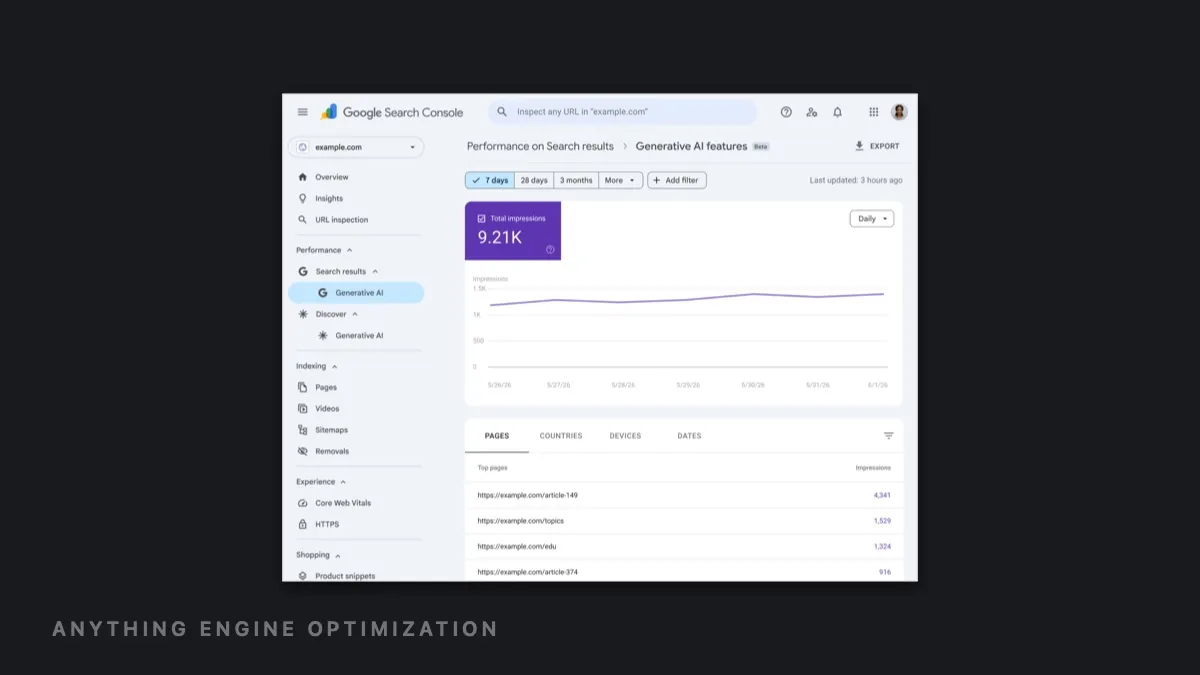
- Sep 13 — Search Console can’t show true AI Overviews link position — Search Engine Journal
Research · 8
- Sep 8 — Semrush: AI Overviews hit 57% of manufacturing searches — Semrush Blog (vendor study)
- Sep 8 — Deep-search AI agents rarely recover from GEO poisoning — arXiv GEO (study)
- Sep 8 — GEO content scores barely predict AI citations, study finds — arXiv GEO (study)
- Sep 10 — Audit: AI answers cite different mental-health sources — arXiv AI-search citations (study)
- Sep 10 — Google DeepMind proposes autoregressive ranking for search — Search Engine Journal
- Sep 10 — Profound: answer engines tailor brand picks to demographics — Profound research blog (vendor study)
- Sep 11 — Study: Google AI Overviews cut Wikipedia search referrals 5% — Search Engine Journal (study)
- Sep 11 — BrightEdge: Reddit’s ChatGPT education citations hit zero — BrightEdge Blog (vendor study)
Engines · 3
- Sep 10 — Google launches a native Gemini app for Windows — Gemini release notes (company announcement)
- Sep 10 — Amazon Ads pilots ChatGPT Ads buying through its DSP — Amazon Ads (company announcement)
- Sep 11 — Adform becomes ChatGPT Ads’ first European tech platform partner — PPC Land
Law & Money · 2
- Sep 9 — Microsoft, Nadella face third AI copyright derivative suit — Chat GPT Is Eating the World (court filing)
- Sep 11 — Anthropic defends fair-use claim against Gilbert — Chat GPT Is Eating the World (court filing)
Tools & Vendors · 2
- Sep 11 — Peec AI launches AI referrals to track chatbot conversions — Peec AI blog (company announcement)
- Sep 13 — People Inc., Atlantic block GPTBot, still bill rivals — Crawler access panel (first-party data)
Via AEO Wire ↗ · Sep 14 · Google Search, AEO, Research
The Monday briefing: the week compiled from the record. Sign up and it lands by email at 7am ET.